He grew up on the island in the 1950s, in a house where the radio played all afternoon and there was always something to draw. The pull toward making images took hold early and never let go.
He learned to see the way an artist sees — a surface as a field of relationships, where one mark quietly changes the meaning of every other. Whatever he made, he made by feel, returning to it until the parts finally agreed.
As a young man he left Cuba for the United States, arriving with little more than his hands and his eye. Miami became home, and home, in time, became a studio — full of glass, brushes, and the particular light of South Florida.
America gave me room to begin again — and the freedom to make whatever I can imagine.
He speaks about that freedom plainly: the chance to work, to build a life, to make art without asking anyone's permission. It is personal rather than political — a steady gratitude that runs underneath everything he sets his hands to.
A whole made of pieces
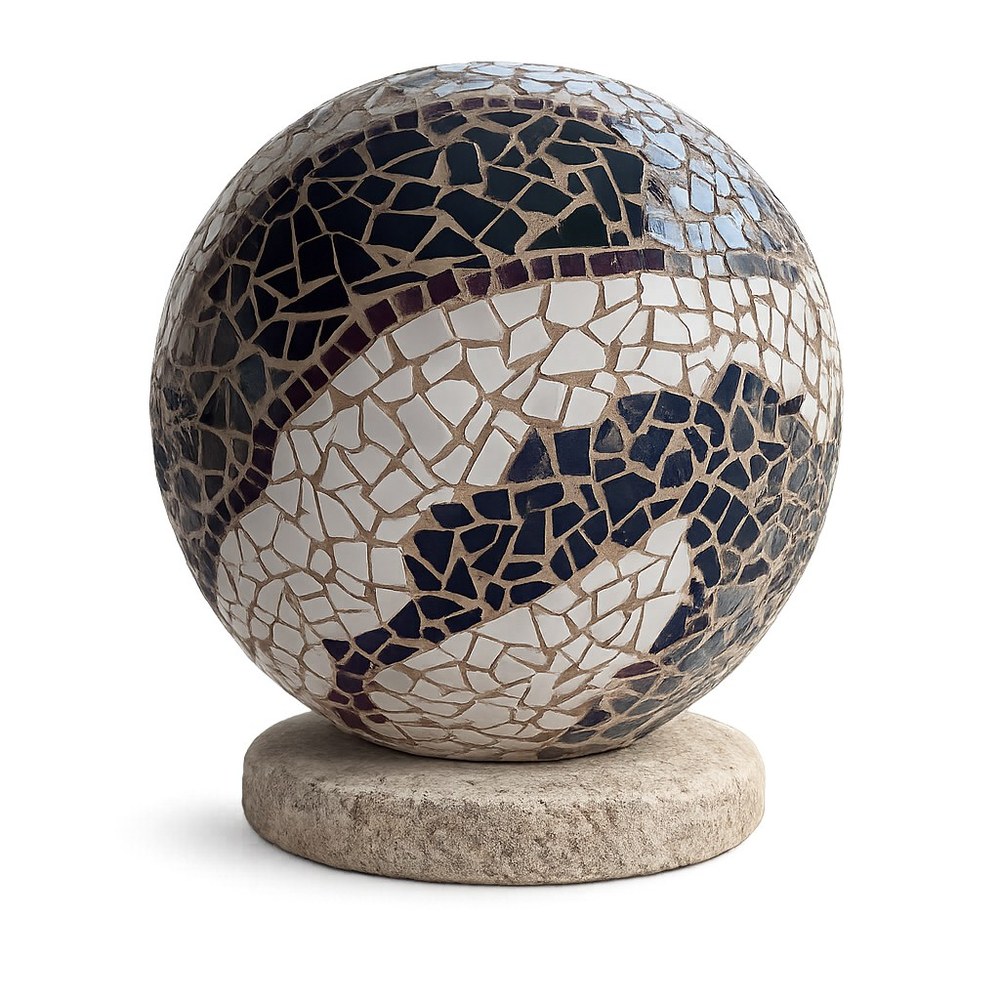
The spherical mosaics came later — a recent turn in the studio — and began as an idea about belonging. Hundreds of cut-glass fragments — each too small to mean much on its own — are set one by one until they curve into a single luminous sphere. He thinks of them as portraits of a life assembled from many places: nothing wasted, every piece holding up the ones beside it.
The colors stay close to home. Greens for cane and palm, blues for the strait he once crossed, and white for a Florida noon — the same three notes that run through the paintings.
Two hands, two tempos
The paintings and the spheres come from the same place but move at different speeds. On canvas he works in oil and acrylic, loosely and quickly, chasing light. In glass he slows almost to a stop, setting one fragment at a time. Different tempos, one pair of hands.